|
■ Developer: Cloudstars®2008
■ Release Date: Q1 2008
■ Version: 1.07
■Minimum System Requirements Software :Win98,
WinMe, Win2000, WinXP, Win VistaDirectX8.1 and above installed
Hardware : P II 300MHZ, 64MB RAM and all 3D accelerator
cards
|
|
 |
|
| |
|
|
|
|
|
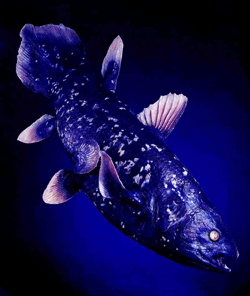
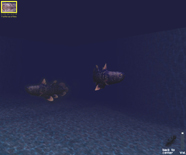 SAN FRANCISCO (CNN) -- An ugly fish known as the "living
fossil" has made another appearance in the ocean, surprising
scientists. SAN FRANCISCO (CNN) -- An ugly fish known as the "living
fossil" has made another appearance in the ocean, surprising
scientists.
A coelacanth has been found in Indonesia -- 7,000 miles (11,200 kilometers) from its only previously
known location near Madagascar.
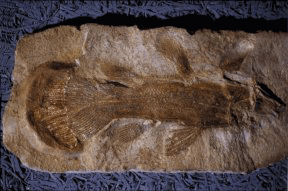
The ancestors of the coelacanth (pronounced SEE-la-kanth)
date back 400 million years. Until 1938, scientists knew the
coelacanth only as a fossilized relic from the dinosaur era.
"So in 1938, it was almost a shock when one showed up, that
you get this, what's called a living fossil basically, this
fish that's known only from the fossil record and here it
is, some 80 million years later, you get a live one," said
Douglas Long of the California Academy of Science.
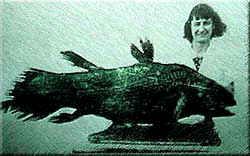
A fisherman pulled the first-known modern coelacanth from
the waters near the Comoros Islands near Madagascar. South African biologist Marjorie
Courtenay Latimer came across it in a fish market.
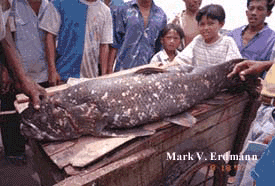
History repeated itself in the latest discovery. University
of California-Berkeley biologist Mark Erdmann was in Indonesia
on his honeymoon when he visited a fish market in Manada,
Sulawesi, to look for manta shrimp, the animal he studies.
"His wife pointed out a large, ugly fish going by on a hand
cart, which he looked at and immediately recognized as a coelacanth,"
said Roy Caldwell, a biologist at UC-Berkeley.
Caldwell said the coelacanths recently found in Indonesia
apparently live in the same type of environment as those found
in the Comoros, caves about 600 feet (18 meters) deep along
the steep sides of underwater volcanoes.
One reason for the coelacanth's ancient popularity was its
fleshy fins that reminded people of human limbs, Caldwell
said. Those fins led to speculation that the fish were direct
ancestors of land vertebrates.
The fish did not turn out to be the ancestor of humans, but
did manage to outlive the dinosaurs. |


 My Cart